
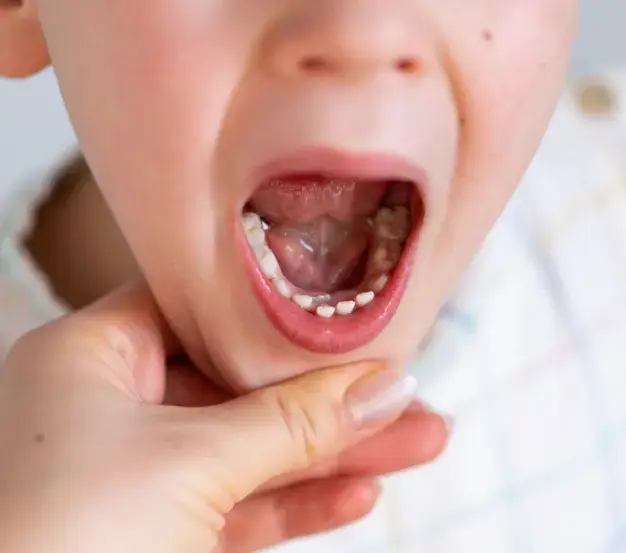
How Tongue and Lip Ties Can Affect Your Child
Tongue ties and lip ties are conditions present from birth, and while the two are related, they are separate physical conditions with their own distinct effects on a child’s mouth. Left unaddressed, either condition can interfere with feeding, speech, and long-term oral health, which is why tongue and lip tie evaluations are a routine part of dental exams at Fox Pediatric Dentistry in Elgin, IL.
When a tie is causing functional limitations for your child, our team can walk you through treatment options in a comfortable, familiar setting. Early evaluation can help identify whether a tongue or lip tie is affecting your child’s comfort, development, or daily activities.
Schedule an EvaluationWhat Is a Tongue Tie?
In most children, the tongue can move freely enough to reach the roof of the mouth and extend past the lower lip without restriction. A tongue tie, medically known as ankyloglossia, occurs when an unusually short or tight band of tissue tethers the underside of the tongue to the floor of the mouth. This restricted movement can lead to a range of issues, including cuts or soreness under the tongue, an increased risk of tooth decay, and difficulty with speech or eating.
What Is a Lip Tie?
A lip tie involves a similar restriction, but the tight band of tissue connects the upper lip to the gums rather than affecting the tongue. Like a tongue tie, a lip tie can interfere with a child’s ability to feed effectively and may contribute to oral hygiene challenges as more teeth come in. Some tongue and lip ties resolve on their own over time, but when a tie continues to cause functional problems, a simple procedure called a frenectomy can correct it.
What to Expect During a Frenectomy
A frenectomy is a straightforward procedure that releases the restrictive band of tissue causing a tongue or lip tie, and it can typically be completed in just a few minutes.
01.
Evaluation
Dr. Justin examines your child’s tongue or lip tie to confirm the diagnosis and determine whether treatment is recommended based on the functional limitations present.
02.
Numbing the Area
Depending on your child’s age, a topical anesthetic may be applied to numb the treatment area before the procedure begins.
03.
Releasing the Tie
Dr. Justin precisely releases the restricting band of tissue, allowing for freer movement of the tongue or lip.
04.
Immediate Results
The procedure itself takes only a few minutes, and improved movement is typically noticeable right away.
05.
Follow-Up Guidance
Before you leave, Dr. Justin provides specific instructions for caring for and cleaning the treatment site as it heals.
When a Frenectomy May Be Recommended
Not every tongue or lip tie needs treatment. At Fox Pediatric Dentistry, Dr. Justin evaluates how the tie affects your child’s daily function before recommending a frenectomy.
A frenectomy may be considered when a tie contributes to:
- Difficulty feeding or latching
- Recurring soreness or injury under the tongue
- Speech concerns related to restricted tongue movement
- Challenges brushing or cleaning around the teeth
- A higher risk of plaque buildup or tooth decay
Caring for the Treatment Site After a Frenectomy
Proper aftercare helps the treatment site heal smoothly and supports the full range of motion the procedure was meant to restore. Dr. Justin will walk you through specific instructions based on your child’s age and the extent of the procedure, which typically include gentle cleaning of the area and simple stretching exercises to prevent the tissue from reattaching as it heals. Most children resume normal eating and activity quickly, with only mild, short-lived discomfort that can usually be managed with basic at-home care.
Correct a Tongue or Lip Tie Now to Prevent Issues Later
If your child has a tongue or lip tie, Dr. Justin can correct it comfortably and conveniently at Fox Pediatric Dentistry. Schedule an evaluation to discuss your child’s symptoms, oral development, and appropriate next steps.
Book an AppointmentFrequently Asked Questions About Tongue and Lip Ties
Common signs include difficulty latching during feeding, clicking sounds while nursing, speech delays, or visible restriction when the tongue tries to reach the roof of the mouth. Our Elgin dental team can confirm a diagnosis during a routine exam.
The procedure is quick and generally well tolerated. A topical anesthetic is often used beforehand to help keep your child comfortable throughout.
The procedure itself typically takes only a few minutes, making it one of the quicker treatments performed at our Elgin office.
Most frenectomies are performed using a topical numbing agent rather than general anesthesia, though this can vary based on your child’s age and specific needs.
In some mild cases, yes. Treatment is typically only recommended when the tie is causing noticeable functional issues with feeding, speech, or dental health.
Recovery is generally quick, and Dr. Justin will provide specific instructions for caring for and cleaning the treated area to support healing.
Yes. An untreated tie can contribute to issues like increased cavity risk, gaps between teeth, or gum irritation, which is one reason early evaluation matters.
Frenectomies can be performed at a range of ages, from infancy through childhood, depending on when the tie is identified and how it is affecting your child.